Odoo cloud hosting: choose who carries the pager.
The word “cloud” does not tell you who patches Odoo, tests restores, supports custom modules or pays the software licence. Odoo Online, Odoo.sh, a cloud VPS and managed Community can all be cloud-hosted—and they solve different problems.
The direct answer: use Odoo Online when standard Odoo fits and you want the least infrastructure work; use Odoo.sh for customized Enterprise with a Git-based platform; use a VPS or on-premise deployment when you need maximum control and can operate it; use managed Community when Community’s features fit but running production should be somebody else’s contracted job.
Start with required apps and custom code. Then assign every operational task. Comparing only monthly hosting prices hides the decision that matters.
Four routes that should not share one label
| Route | Best when | Custom modules | Operations owner |
|---|---|---|---|
| Odoo Online | Standard apps and minimum administration | No ordinary custom or Apps Store server modules | Odoo operates platform; you operate business configuration |
| Odoo.sh | Customized Enterprise deployment | Yes, through repository and build workflow | Odoo runs platform; your team owns code and releases |
| Cloud VPS / on-premise | Control, Community, private networking or unusual architecture | Yes, subject to licence and compatibility | Your team |
| Managed Community | No Enterprise per-user licence and outsourced operations | Community-compatible modules | Provider by contract; you still own process and access decisions |
The simplest cloud is deliberately constrained
Odoo’s Odoo Online documentation describes private databases hosted and managed by Odoo, available through a browser without local installation. It supports configuration and customizations that do not require custom code. The same page says Online is incompatible with custom modules and Apps Store modules.
Online includes managed infrastructure, daily backups under Odoo’s cloud SLA, database duplication and downloadable backups. That is compelling when the standard application fits. It is a poor fit if a Python addon, arbitrary server package, private network route or direct infrastructure control is non-negotiable.
Plan features and prices change by country, billing term, promotion and date. Check the official pricing page in your region. Do not turn today’s displayed dollar figure into a five-year constant.
A managed platform does not manage your requirements
Odoo.sh is Odoo’s official cloud platform, with shell access, module dependencies, continuous integration and SSH. Its getting-started guide connects a GitHub repository, Odoo.sh project and database into a development pipeline.
It is for Enterprise projects: Odoo’s project-creation documentation requires an Enterprise subscription code for a client project. Budget the applicable Enterprise plan and Odoo.sh resources together. Your developers still own module quality, dependency choices, test coverage, merge decisions and functional validation.
The branch documentation says production is backed up automatically, including the database and filestore. Staging and development have different backup behavior. Good platform defaults reduce work; they do not remove the need to know which environment contains valuable data and to rehearse recovery.
A VPS in a cloud account is still self-hosting
Renting compute from a famous cloud provider does not make Odoo managed. If your team controls Linux, PostgreSQL, Odoo, the proxy and deployment pipeline, your team owns their failures. The same is true on office hardware or in a data center.
Odoo’s production deployment guide is explicit: secure Odoo with HTTPS, restrict database management, configure database filtering, and back up both databases and filestore to a remote archive inaccessible from the application server. Add current bug-fix builds, monitoring, capacity alerts, restore tests, incident ownership and a major-version upgrade plan.
Self-hosting is rational when control creates real value. It is not rational when “someone set up Docker once” is the entire operations model.
Outsource the stack, not accountability
Odoo 19 Community is LGPLv3 according to Odoo’s official licence page. It can run on cloud infrastructure without an Enterprise subscription. A third-party managed host can provision and operate that deployment for a flat or resource-based fee.
Ask exactly what “managed” means: response times, operating-system and Odoo updates, monitoring, backup destinations, retention, restore testing, test environments, module support, upgrades, data export and exit assistance. Community removes the Enterprise per-user licence; it does not remove hosting or engineering.
Managed Community also does not become an official Odoo cloud. The provider is independent, and Enterprise-only applications and official Odoo Enterprise services are not silently included.
Reject any option that cannot answer these six questions
- Where are HTTPS terminated and certificates renewed?
- Are PostgreSQL and the filestore backed up together to remote storage?
- When was a complete restore last tested?
- Who applies current supported Odoo builds and security fixes?
- What monitoring detects downtime, resource exhaustion and failed backups?
- What is the tested path to the next major Odoo version?
Also document recovery objectives, data region, access logging, module ownership and who can export the database. A provider’s feature list is not a responsibility matrix.
Compare three-year responsibility, not one invoice
Model software licences, platform resources, compute, storage, backup egress, test environments, monitoring, administration, incident response, custom-module maintenance and upgrades. Add user growth for per-user plans. Add engineering hours for self-hosting.
Official prices and offers are dynamic. Verify country, currency, taxes, billing term, introductory discount, included storage and renewal basis on the purchase date. Apply the same discipline to independent providers; competitor numbers age too quickly to serve as evergreen truth.
Official Odoo references
FAQ
What is the best Odoo cloud hosting option?
Odoo Online is usually best for standard Odoo with minimal operations. Odoo.sh fits customized Enterprise. Self-hosting fits organizations needing control and able to run production. Managed Community fits Community users who want operations contracted out.
Does Odoo cloud hosting support custom modules?
It depends on the model. Odoo Online does not support ordinary custom server modules. Odoo.sh supports custom modules through its Enterprise development workflow. Self-hosted and managed Community deployments can run compatible, correctly licensed modules.
Is Odoo.sh included in the Enterprise subscription price?
Do not assume so. Odoo’s pricing page currently says Odoo.sh hosting cost is not included. Pricing varies by country, date, resources and contract, so verify the complete quote directly with Odoo.
Can Odoo Community run in the cloud?
Yes. Community is LGPLv3 software and can run on a cloud VPS or through an independent managed provider without an Enterprise per-user licence. Infrastructure and operations still cost money.
Continue the hosting decision
Odin is one option, not Odoo’s official cloud.
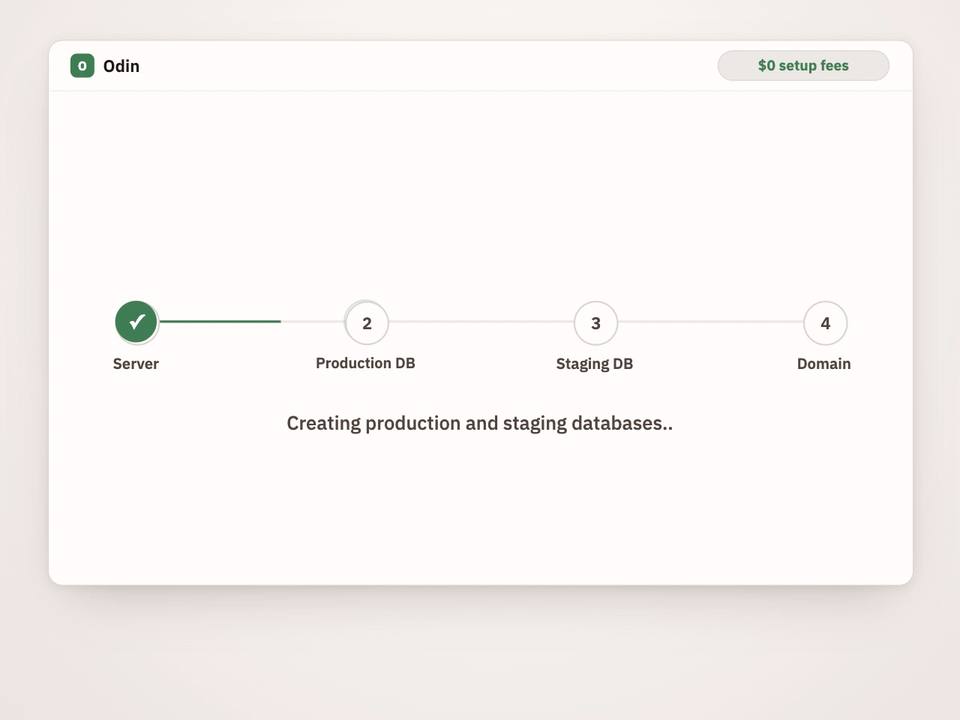
We sell managed, standard Odoo Community: automated provisioning, live and test copies, and an industry/country template where available, for a flat monthly fee with no Enterprise per-user licence. Compare the exact scope before choosing us.