The best Odoo partner for wholesale is the one who can name your 856.
Every “top 10 Odoo partners” list is a sales page. Odoo’s own directory is a starting set — Gold, Silver, Ready — and even Odoo says the badge is not the whole decision. Gold measures Enterprise users sold, certified heads, and retention. It does not measure whether anyone on that team has posted an ASN to a named retailer.
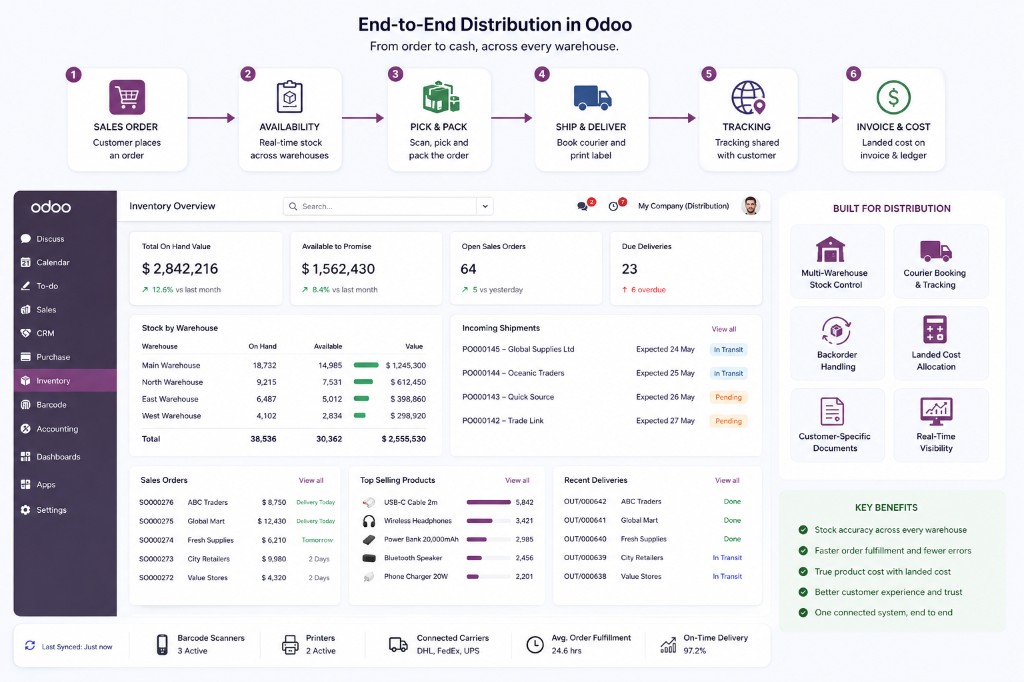
This page will not rank firms. Ranking firms we do not implement with would be fiction. The useful work is a checklist you can verify on a reference call — then decide whether you need that partner at all.
Odoo itself says you might not. Their partner-selection article lists DIY, Odoo’s own implementation services, or a partner. We sell a distribution setup and flat-fee hosting. The section on when a specialist is still the right buy is written straight.
Start on odoo.com/partners. Then ignore the badge.
Official list: odoo.com/partners. Filter by country and grade. That is the honest starting set — not a blog’s “top 10” that happens to be the author’s employer plus two affiliates.
Odoo’s Partnership Agreement (v11, 19 May 2023) is explicit about what the grades measure. Reviewed quarterly:
| Ready | Silver | Gold | |
|---|---|---|---|
| Net new Enterprise users / 12 months | 10 | 75 | 300 |
| Certified employees on a recent version | 1 | 3 | 6 |
| Minimum retention (3-year cohort) | — | 70% | 80% |
That is sales capacity and certified headcount. It is not a warehouse certification. Odoo’s own how to choose a partner post says the same thing in plain language: Gold partners are the largest, and they “might not represent the optimal choice for every project.” They tell you to weigh methodology, similar-industry experience, proximity, cost, IP of custom code, and upgrade maintenance.
A Ready partner who has gone live on X12 850/855/810/856 for a named big-box account will beat a Gold partner whose demo is a single warehouse and a pricelist. Ask for the reference, not the logo.
Standard Inventory is a WMS, not a blank page
Odoo Inventory is documented as inventory and warehouse management: lead times, replenishment, advanced routes. Shipping and receiving covers one-/two-/three-step receipts and deliveries, putaway, dropshipping, batch/cluster/wave picking, FIFO/LIFO/FEFO.
Landed costs are a first-party feature: enable them in Inventory settings, mark a product as a landed cost, split freight/duty onto a validated receipt. A partner who puts freight in a spreadsheet after go-live is not using the product.
A partner who leads with “we will custom-build multi-warehouse” before asking which of those flows you already need is selling hours. A partner who opens the database and configures routes is doing the job. Our day-one distribution pack is the second shape. What’s installed.
Odoo’s “EDI” page is not retailer ASN EDI
This is the most common bait-and-switch in wholesale quotes. Odoo documents three different things people call “EDI”:
- Purchase-to-sales XML between two Odoo databases — export a PO as XML, import it as a sales order on the other side. That is the EDI purchase-to-sales chapter. It is not Walmart.
- Electronic invoicing — Peppol and country formats on customer invoices. Odoo’s e-invoicing docs. Still not an 856.
- Retailer / 3PL EDI — X12 or EDIFACT 850/855/810/856 through a VAN or a mapping house (SPS Commerce and the rest). Odoo does not ship that as a first-party “big-box pack.” It is a specialist project.
If the quote says “we do EDI” and the demo is the XML upload between two Odoo databases, you have been shown the wrong product. Ask which documents, through whom, for which retailer, and for a scorecard screenshot from a live account.
Nine questions that separate a distribution partner from a website partner
- Name a live multi-warehouse customer, and which reservation method they use. Closest warehouse, cheapest, or availability-aware is a design choice. Silence means they demoed one location.
- Which retailer EDI documents, through whom? 850/855/810/856 via a named VAN is a different project from Odoo’s XML purchase-to-sales import. Ask for a scorecard screenshot, not a slide.
- How does landed cost hit the ledger? Freight, duty and clearing on the product via Inventory’s landed-cost feature, not a journal the warehouse ignores.
- Customer pricelists: volume breaks, contract prices, and who may override. Wholesale dies on the wrong price printing on the delivery note. Ask who is allowed to discount, in Odoo, not in email. If product ownership is also in scope, use the Odoo wholesale PIM checklist.
- 3PL and dropship. Odoo documents dropshipping. Ask whether they have connected your 3PL’s API or only a lab ShipStation.
- Barcode on the floor, not in the demo. Handheld receive / pick / pack / ship. If the reference still keys quantities, the WMS is not live.
- Config vs custom, in writing, as a percentage of the quote. Custom modules are rewritten at every upgrade — published ranges on this site run $10,000–$40,000. Upgrade cost · Implementation cost.
- Whose Odoo account is the database under? Ask in writing. Partners have created client databases under the partner account. Odoo also tells you to clarify IP of custom code if you later change partner. Who owns your database.
- What does a small change cost after go-live? A new route, a customer-specific delivery note, an extra discount rule. If every one is a quote, you are buying a five-year change-request business. Implementing without a partner.
When a specialist partner is the right buy
Hire one when go-live failing means you cannot ship. When a retailer will fine you for a bad 856. When you are cutting over a live warehouse with open picks. When payroll or tax in your jurisdiction is not something an offshore generalist should guess. That is insurance, not a badge.
Do not hire a full implementation partner to turn on Inventory, import a product CSV, and train pickers on barcode. Those are jobs 2, 3 and 5 in what a partner actually does, and they are mostly work. Hosting, backups and version upgrades are a service, not a project — that is why we sell them as a flat fee instead of a partner retainer.
Where Odin is not a substitute for that partner
- EDI to a named big-box with a live scorecard. We have not claimed that as a product. Get a partner who has the VAN and the mapping already.
- Regulated industry processes with no Odoo equivalent. Unusual bonded-warehouse or pharma serialization rules need local expertise.
- A cutover where the floor cannot miss a day. Buy the insurance.
Where we are in the picture: Community hosting, the distribution module pack, courier labels, landed cost, and changes described in plain English onto a test copy. $150/month up to 25 people or $450 unlimited. Pricing. Agencies who want to keep the client can resell that at wholesale — that is a different “partner” page: Odin for agencies.
Official documentation
- Odoo Partnership Agreement (v11) — Ready / Silver / Gold thresholds
- Odoo: How to choose the right partner — Gold is not always optimal; DIY is an option
- EDI purchase-to-sales (Odoo-to-Odoo XML) — not retailer ASN
FAQ
Who are the best Odoo partners for wholesale and distribution?
There is no honest global ranking. Use Odoo’s partner finder, then verify retailer EDI, multi-warehouse and landed cost on a named reference. Gold measures Enterprise users sold, not warehouse skill. Odoo says so too.
Is an Odoo Gold partner better for distributors?
Gold requires 300 net new Enterprise users in 12 months, six certified employees, and 80% retention — from the Partnership Agreement. Ask whether they have gone live on your flows: three-step delivery, retailer EDI, 3PL. Not what badge they hold.
Does Odoo include EDI for big-box retailers?
No. Odoo’s “EDI purchase-to-sales” chapter is XML between two Odoo databases. Peppol is e-invoicing. Retailer 850/856 traffic goes through a VAN or mapping house. Treat those as three different products.
Do I need a partner to run Odoo for wholesale?
Not always. Odoo lists DIY and Odoo’s own implementation services as options. Standard Inventory already covers warehouses, routes, replenishment and multi-step picking. You need a specialist when retailer EDI, a brutal cutover, or a regulated process is the risk. Without a partner.
What should a wholesale Odoo implementation include on day one?
Inventory, Purchase, Sales, barcode on the floor, accounting that matches stock valuation, customer pricelists, and a written rule for backorders. Courier booking and landed cost are the pieces partners usually quote extra. Our distribution setup.
Should the partner own my Odoo database?
No. The subscription and database should be under your company. Ask in writing before you sign — including IP of custom code if you later change partner. Who owns your Odoo database.
Implementation cluster
If the warehouse is standard, you don’t need a 40-page SOW.
Distribution pack, hosting and upgrades on a flat fee. Specialist EDI is still a specialist.