The integration installed fine. It just couldn't answer a single question.
The install passed. The connection handshake passed. Every test passed. Then the first real question came back empty — and so did the next four. A post-mortem on the gap between shipping software and shipping something usable.
We shipped an Odoo app that connects AI assistants to your ERP. Install succeeded. OAuth handshake succeeded. The assistant reported itself connected, and the connection was genuinely live.
Then someone asked it what last month's sales were, and it said it had no access to sales orders.
They asked what was in stock. No access to stock.
They asked what it could see, and it answered, accurately: contacts, companies, countries and currencies.
Nothing had failed. There was no error to look up, no exception in the log, no red anywhere. We had built a working connector to a system full of business data that could describe the currency table.
Here are the five failures behind that, in the order we found them. None of them raised an error. Every one was invisible from inside the thing that was broken.
The permissions we shipped were the permissions nothing could use
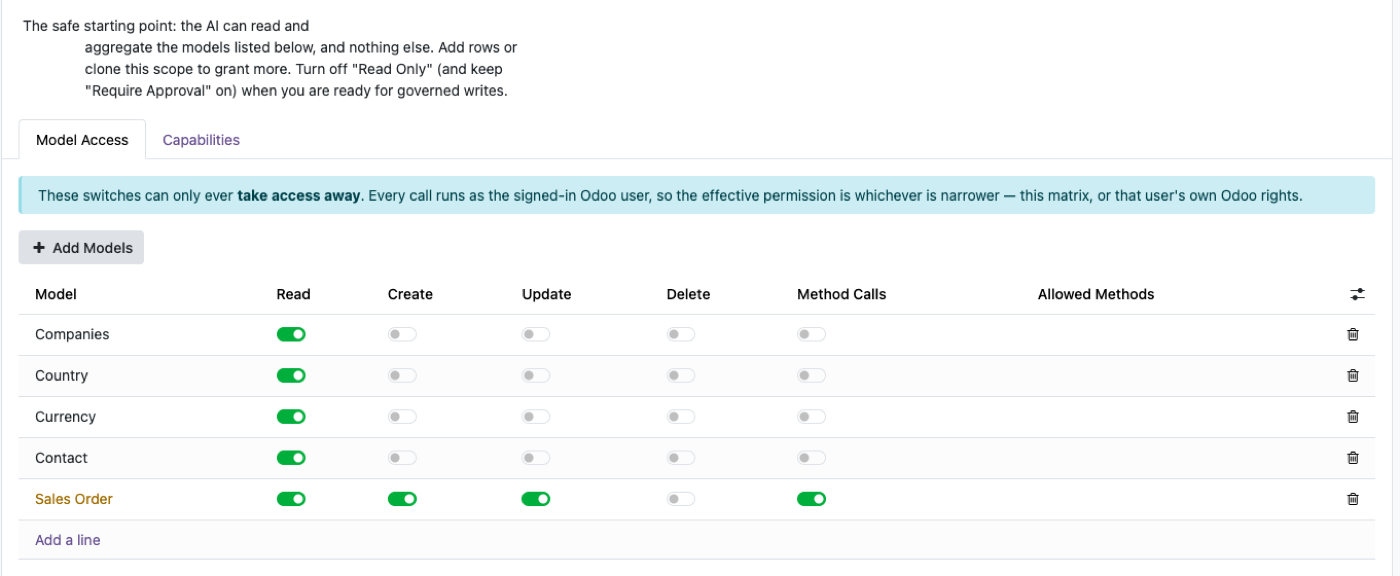
A new install seeded a read-only scope covering four models: contacts, companies, countries, currencies. All four belong to the framework, not to any business app.
This was not laziness. It was a constraint we had reasoned ourselves into.
Odoo data files are declarative and they resolve their references at install time. A data file that names sale.order fails the install on any database without the Sales app. Not gracefully — the module refuses to install. So the safe set was the set present in every database, which is the framework's own tables, which is nothing anyone asks questions about.
We had correctly identified a real constraint and then accepted its worst consequence as fixed.
The way out was to stop declaring and start resolving. A post-install hook runs Python, and in Python a missing model is an empty result rather than a fatal error. So the hook walks a list of models a business actually asks about — sales, purchasing, invoicing, stock, CRM, projects, employees — looks each one up at run time, and adds the ones this database happens to have. Absent apps are skipped in silence.
Which took us far too long to see: when a declarative format forces you into a bad default, the answer is usually to move the decision to run time, not to accept the default.
Nobody could find the app
The module defined a permission group. Menus were gated on it, correctly. Record rules keyed off it, correctly.
Nothing granted it.
Administrators had it, because administrators inherit everything. So it worked perfectly for every person who tested it, and was invisible to every other employee in the company. The app was installed. It did not appear.
Nobody reported this, which is the interesting part. Nobody files a bug about a menu they have never seen. The failure had no symptom, because its symptom was absence.
The fix was two lines, granting the role to every internal user. What took the time was the argument, and the argument is worth repeating: was this a security decision or a navigation decision?
It is navigation. The three gates that matter — the read-only default scope, the per-model permission matrix, and the user's own access rights underneath both — were all untouched. Someone reaching the menu can connect an assistant that sees exactly what they can already see. Withholding the menu was never protecting anything. It was just hiding the product from its users.
If a group only controls visibility, granting it is a UX decision, and hiding behind “it's a permission” is how a feature ships to nobody.
The URL was right and kept becoming wrong
The screen showed the server address to paste into your assistant. Behind a TLS-terminating proxy it showed http://, and every AI client refuses a plain http endpoint — with an error that never mentions the scheme, so the user has no idea what went wrong.
Two causes, compounding, and the second is the nasty one.
Odoo only applies proxy header handling when proxy_mode is on and the proxy sends X-Forwarded-Host. Front ends that send X-Forwarded-Proto without it — Cloudflare among them — leave the scheme as http no matter how you configure it.
And Odoo rewrites its own recorded base URL to wherever an administrator last signed in from, unless a second parameter is set to freeze it. So on such a deployment, an administrator fixing the address by hand would watch it revert on their next login. Working connector on Monday, silently broken by Wednesday, no change anyone made.
That second one is the kind of bug that destroys trust in a product, because the user's mental model — “I fixed it, it's fixed” — is correct everywhere except here.
We now derive the public address from the forwarded headers directly, never downgrade https once anything has reported it, and offer a one-click fix that pins and freezes the value. The manual route existed the whole time. It required knowing that developer mode, System Parameters, and a second undocumented parameter all existed. That is not a fix; it is a scavenger hunt.
We suggested things we would then refuse
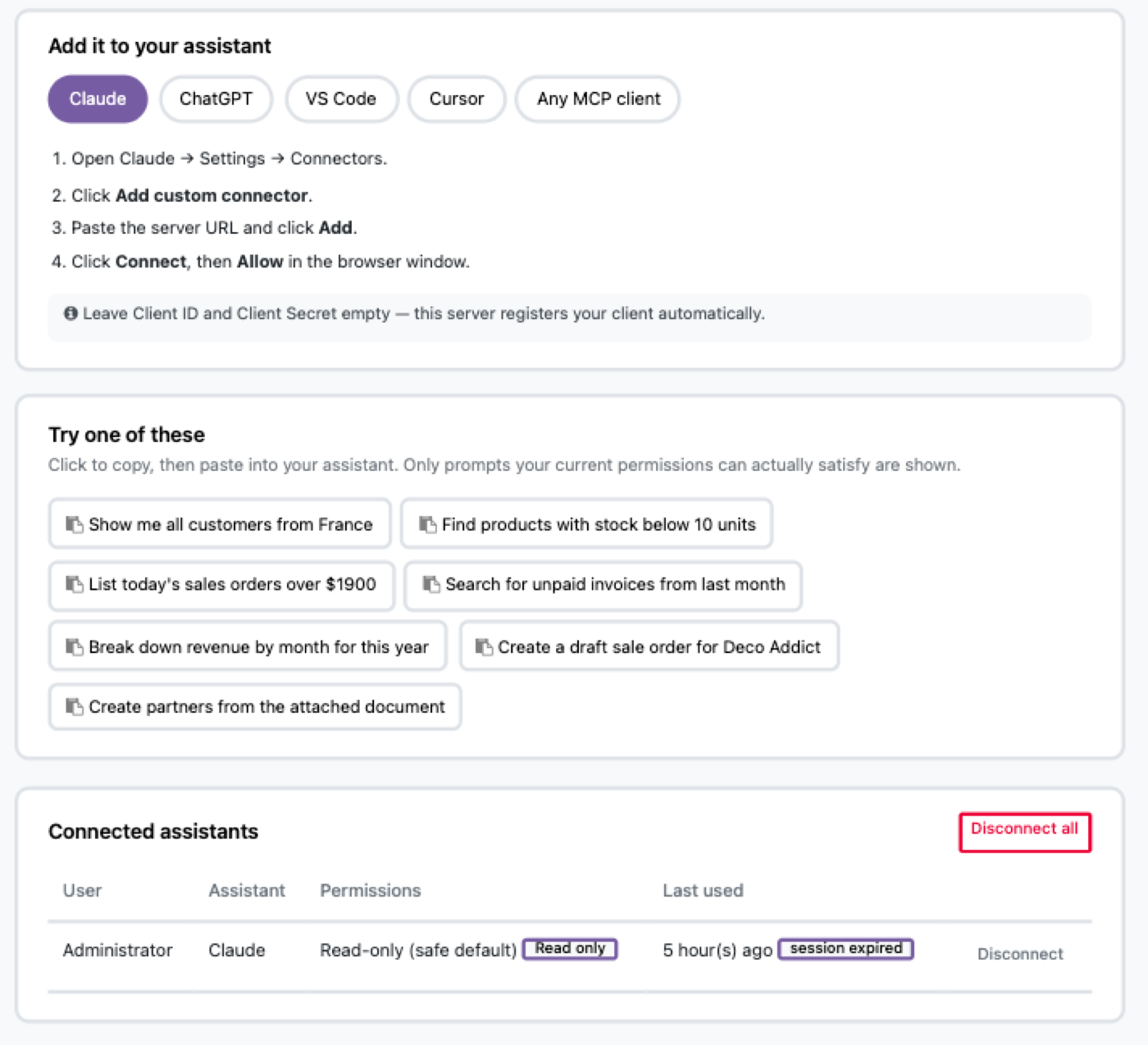
The screen offered starter prompts — click to copy, paste into your assistant. “List today's sales orders over $1,900.” “Search for unpaid invoices.”
On a fresh install, per failure 1, none of those models were readable. So the first thing a new user did was click a suggestion, hand it to their assistant, and get told access was denied.
The chip was ours. The refusal was ours. To the user it was one experience, and the experience was this product is broken.
Suggestions are a promise. If your UI proposes an action, the action has to work — otherwise the suggestion is worse than the blank screen it replaced, because a blank screen does not make a claim.
Prompts are now filtered twice: against the permission matrix, and against the user's own access rights. A warehouse user is not offered a finance question they would be refused. Two prompts that work against any configuration always lead, so the list is never empty.
Nothing proved anything
This one is not a bug. It is the failure the other four grew in.
Our setup screen ran a careful checklist. Public address: correct. Reachable from the internet: yes. Database selector off. Permissions configured. Server enabled. Every row green.
Every row was a precondition. Not one of them was evidence. You could pass the entire checklist and still be unable to answer a question — which is precisely what happened, five times over, while the screen showed green.
So we added one button: Run a test question as me.
It picks a model the user can actually read, and issues a real tool call through the real engine — every permission gate, the real audit trail, running as them — then shows the rows that came back. It is not a mock and not a ping. It is the same code path a connected assistant uses.
It found failure 1 immediately, in a way that five green checkmarks had not.
It generalises past our product: a checklist of preconditions is not a test. If your setup flow cannot demonstrate the thing working end-to-end, it is asking the user to be the integration test — and they will run it in their assistant, where the failure looks like your product being broken rather than your product being unconfigured.
What connects all five
Every one was invisible from inside the system that had the problem.
- The scope could not know it was thin, because four models is a valid scope.
- The menu could not know nobody saw it, because it rendered correctly for everyone who looked.
- The URL was correct at the moment we generated it.
- The prompts were valid strings.
- The checklist was accurate about everything it checked.
Each component was locally right. The product was globally useless. And no integration test we could have written would have caught it, because every test we could write ran with an administrator, on a database we controlled, in an environment we set up — which is to say, as the one user for whom none of these failures existed.
The only thing that finds this class of bug is asking, in the user's position, with the user's permissions: can it actually do the thing yet?
That question is now a button on the first screen.
Closing
There is a version of this post that is a list of bugs, and it would be less useful. The point is not that we had five failures. It is that “installed successfully” and “usable” turned out to be separated by five distinct problems, none of which any conventional signal — build, test, install, connect — could detect.
If you ship integrations, the gap is worth measuring in your own product. Install it as a real user, on a database you did not prepare, and ask it to do the first thing your documentation promises.
Our gap was five failures wide. I do not think that is unusual. I think it is just unusually measured.
Written while shipping AI MCP, which connects Claude, ChatGPT, Cursor and any MCP client to Odoo. Every failure above is real and every fix above is in the current release.
Related reading
Install it as a real user. Ask it the first question.
The sandbox is live, on sample data, with nothing to sign up for.