Your MCP server caps results at 200 rows. Your AI doesn't know that.
A row cap is a good idea that quietly turns a correct database into a confidently wrong answer. Here is why it happens, why it is worse than an error, and the three-line fix that belongs in every MCP server.
Someone asks their assistant: how many overdue invoices do we have?
It runs a search against the ERP, gets 200 rows back, counts them, and answers: “You have 200 overdue invoices, totalling $412,000.”
The real number is 1,847, totalling just under four million.
Nothing failed. No exception was raised, nothing was logged, no error reached the user. The database was right, the server was right, and the model did exactly what the data told it to do.
That is the problem.
Where the 200 comes from
Any MCP server that exposes a search tool over a real database needs a row cap. Without one, a model that decides to “have a look at the orders table” can pull half a million rows into a context window, and take the database down on the way. So you write something like this, and you are right to:
limit = min(requested_limit or 200, scope.max_records)
records = env[model].search_read(domain, fields, limit=limit)
return {"model": model, "count": len(records), "records": records}
The cap is correct. The bug is in the last line.
count is the length of the page. On any result set larger than the cap, it equals the cap — so the reply says count: 200 whether the true answer is 200, 201, or two hundred thousand. The response contains no signal, anywhere, that it has been truncated.
Why this is worse than an error
An MCP client handles a tool error well. isError: true with a readable message is something a model can reason about: it will apologise, narrow the query, ask you a clarifying question. Errors are recoverable, and the whole tool-calling loop is designed around them.
A truncated success is not recoverable, because nothing about it looks wrong.
Consider what the model has to work with. It sees a well-formed response with a plausible number of well-formed rows and a field explicitly labelled count. It has no access to your source, no visibility of your configuration, and no memory of what your cap is. Every heuristic available to it says the query succeeded.
So it does the reasonable thing and reports the answer. The failure surfaces weeks later, in a meeting, when someone notices the number was wrong — and by then nobody remembers which question produced it.
This is the specific failure mode that makes people distrust AI over business data, and it is almost always the server's fault rather than the model's.
The fix
Fetch one row past the cap. Return the cap's worth. Say what you did.
limit = self._clamp_limit(scope, args.get("limit"))
records = env[model].search_read(domain, fields, limit=limit + 1, offset=offset)

has_more = len(records) > limit
records = records[:limit]

return {
    "model": model,
    "count": len(records),   # rows in THIS page
    "limit": limit,          # the cap that applied
    "offset": offset,
    "has_more": has_more,    # is there anything past it
    "records": records,
}
The extra row is never returned. It exists only to answer the question “was there more?” — one row of cost for the difference between an answer and a guess.
Then say it again where the model will actually read it, in the tool description:
The reply carries
count,limitandhas_more. Whenhas_moreis true there are further matching records beyond this page — page withoffset, narrow the domain, or aggregate instead, and never present a capped page as the complete answer.
That sentence does more work than the schema does. The model reads tool descriptions before it decides how to use a tool; it reads your field names only after it already has the data.
The same bug, four more times
Once you see the shape of it, it is everywhere. Every boundary your server enforces must be visible in the response it returns. A boundary the caller cannot see is a boundary the caller will misreport.
Audit your own server for these:
- Aggregations.A capped
read_groupis worse than a capped search, because the result still totals up. Revenue by month with the last four months silently missing looks exactly like revenue by month. - Name lookups.Truncate a name search and the model picks the first “Acme” it sees — then writes to it. A cap on a search is a reporting bug; a cap on an entity resolution is a data-integrity bug.
- Permission filtering.If your row-level security drops records before they reach the response, the model reports what it can see as what exists. Sometimes you cannot disclose the difference. But you can usually say that there is a difference.
- Archived and soft-deleted rows.If your permission layer hides them at call time but your
list_models-equivalent still advertises them, you are promising access that every subsequent call refuses.
Each one has the same fix: return the boundary alongside the data.
The underlying principle
Tool design for language models is API design under two constraints that do not apply to normal APIs.
Your caller cannot read the docs at runtime. A human integrator reads your documentation, discovers the cap, and writes pagination. A model gets one in-context description and whatever your response contains. Anything not in those two places does not exist.
Your caller cannot see your logs. When a human integration behaves oddly, someone opens a dashboard. When a model's tool call is silently degraded, the degradation is invisible on both sides — the model does not know, and the user sees a confident sentence.
Which produces a rule worth writing on the wall:
A tool result should be interpretable by someone who can see only the tool result.
Not your source. Not your config. Not your logs. If a fact is required to read the response correctly, that fact belongs in the response.
Four questions for your own server
Run these against whatever you have shipped:
- Can a caller tell a full page from a complete result set?
- Does every cap, filter and default that shaped the response appear in the response?
- Does the tool description say what to do when a limit is hit — not just that one exists?
- If you deleted every log line and every doc page, could a reader still interpret the payload correctly?
If the answer to any of them is no, you have this bug. It is not exotic and it is not rare. It is the default behaviour of the most obvious way to write the code.
Closing
The uncomfortable part is that a row cap is good engineering. It protects the database, it bounds the context window, it is exactly what a review would ask for. It became a correctness bug only because the response never mentioned it.
That is the thing to take away, and it generalises well past MCP: a safety mechanism the caller cannot observe is indistinguishable from a lie. Not because anyone lied — because the truthful part was never sent.
I maintain an MCP server for Odoo, which had exactly this bug until recently. The fix above is what shipped. It is three lines, and if you run an MCP server over anything with more rows than a context window, it is probably three lines you need too.
Related reading
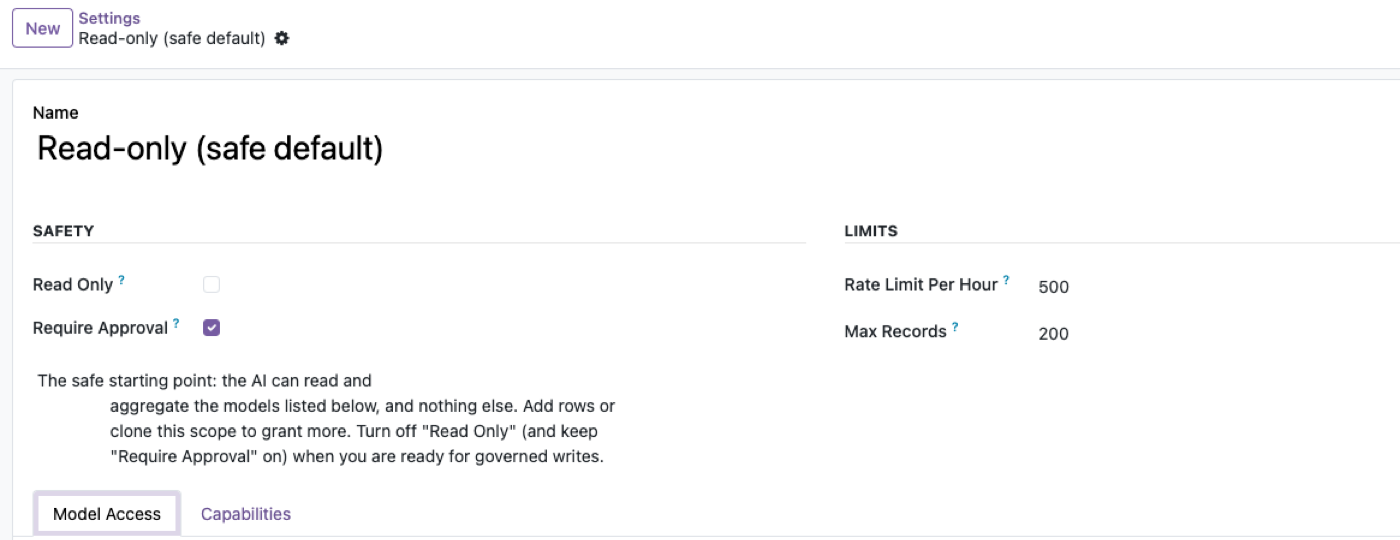
See the caps in a real server.
Open the sandbox and read the scope screen the screenshots came from.